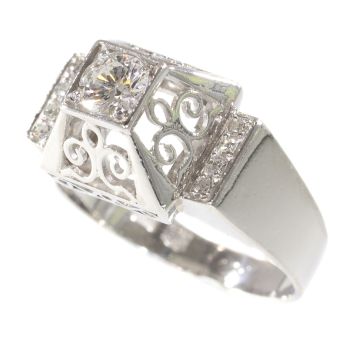
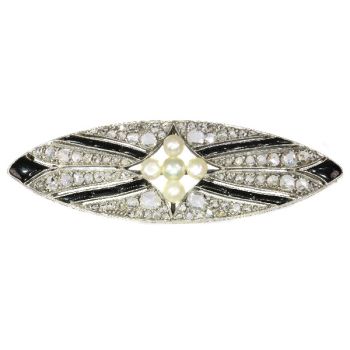
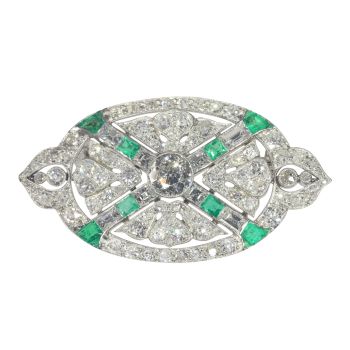
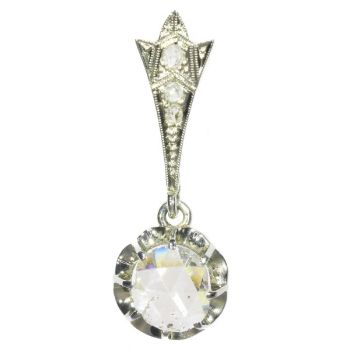
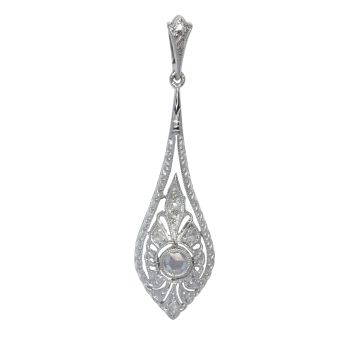
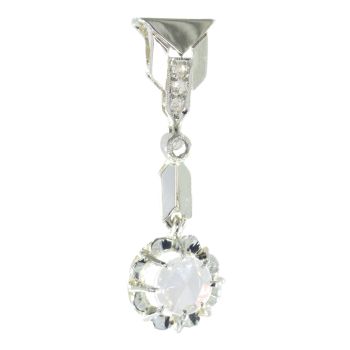
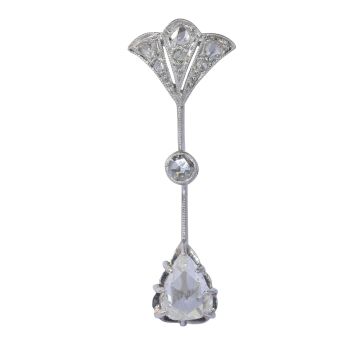
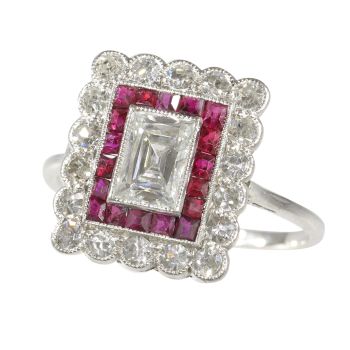
Art Deco pendant, circa 1930, in 18K white gold, centred on an octagonal onyx plaque with a prominent rose cut diamond in a milgrain bezel. The slender, stepped suspension is set with further rose cut diamonds and small rose cut diamonds, giving a crisp play of light against the black ground. Neat, architectural and quietly glamorous, it wears like a small piece of the Jazz Age.
Jewellery Type
pendant
Condition
very good condition
more info on our condition scale
Country of origin
unknown
Style
Art Deco - Art Deco is an eclectic artistic and design style which had its origins in Paris in the first decades of the 20th century. The style originated in the 1920s and continued to be employed until after World War II. The term "art deco" first sawwide use after an exhibition in 1966, referring to the 1925 Exposition Internationale des Arts Décoratifs et Industriels Modernes that was the culmination of high-end style modern in Paris. Led by the best designers in the decorative arts such asfashion, and interior design, Art Deco affected all areas of design throughout the 1920s and 1930s, including architecture and industrial design, as well as the visual arts such as painting, the graphic arts and film. At the time, this style was seen aselegant, glamorous, functional and modern.
See also: Art Deco
more info on styles
Style specifics
Abstract motives and geometrical forms are quite typical for the Art Deco period. Art Deco moved away from the soft pastels and organic forms of its style predecessor, Art Nouveau, and embraced influences from many different styles and movements of the early 20th century, including Neoclassical, Constructivism, Cubism, Modernism,and Futurism. Its popularity peaked in Europe during the Roaring Twenties and continued strongly in the United States through the 1930s. Although many design movements have political or philosophical roots or intentions, Art Deco was purelydecorative.
Period
ca. 1930
Events & facts of this era, poetry of this era, fashion of this era.
Material 18K
white gold (touchstone tested)
more info on precious metals
Diamonds
Set with one prominent rose cut diamond, presenting a face up size similar to a round brilliant of around 0.75 ct (approximate equivalence).
Fourteen rose cut diamonds and senailles. A senaille is a simplified rose cut diamond, a small diamond chip with perhaps a few polished facets. We do not have the weight of the rose cuts diamonds nor the senailles which is normal in our trade when it comes to rose cut diamonds and senailles.
- When we provide weights, colour grades, and clarity of diamonds, these are approximate unless otherwise stated, as we do not remove diamonds from their settings to preserve the integrity of the piece.
- All diamonds, regardless of their size or shape, in our vintage and antique jewellery are verified as 100% natural by the IJGC laboratory.
Precious stones
One onyx
Birthstones
Diamond is the birthstone (or month stone) for April and onyx for July.
more info on birthstones
Hallmarks
No trace.
more info on hallmarks
Dimensions
3,30 cm (1,30 inch) x 1,36 cm (0,54 inch)
see picture with a ruler in millimeters and inches
Weight
2,20 gram (1,41 dwt)
Adin Reference Nº
26019-0135
Copyright photography
Adin, fine antique jewellery
Additional information
our latest acquisitions
jewelry glossary
wall of fame
visit us in Antwerp
subscribe to our mailinglist