Mauritius  by Francois Valentijn
Scroll to zoom, click for slideshow

Mauricio 1724

Francois Valentijn

Actualmente no disponible a través de Gallerease

  • Sobre la obra de arte
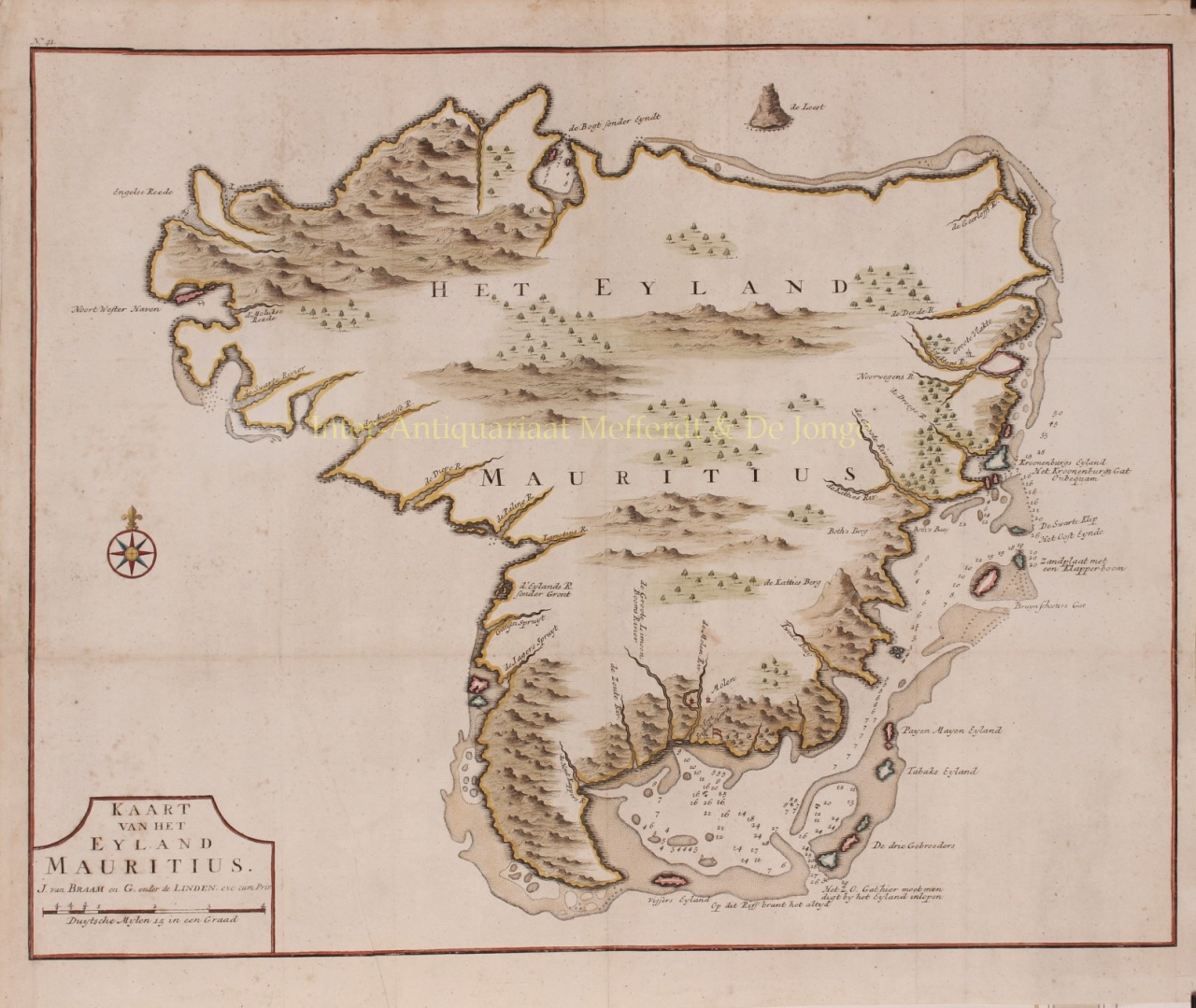
    “Kaart van het Eyland Mauritius” [map of the island Mauritius], from François Valentijn’s “Oud en Nieuw Oost-Indien”, after a drawing by Johan van Leenen, engraved by Jan van Braam and published in Dordrecht by Gerard onder de Linden in 1724-1726. Coloured by a later hand. Size.: 43 x 54 cm. Wybrant van Warwijck was the first Dutchman to arrive on Mauritius on September 18, 1598. Van Warwijck had strayed with five ships from the rest of the fleet of the so-called Tweede Schipvaart [second Dutch expedition], trying to reach Madagascar. He is said to have named the green island after Stadtholder Prince Maurice. The Dutch East India Company (VOC) initially only used the island as a refreshment station and did not permanently inhabit it. Mauritius had two good natural harbours suitable for larger ships, in the Northwest "Port de Warwick" (nowadays Port-Louis) and the Southeast. The Northwestern harbour was a sheltered bay and the Southeastern was protected by a series of islands and reefs. Valentijn reports that it was very stormy around February. Mauritius was a fertile island, rich with birds, the most important of which was the dodo for food, turtles and manatees. Pigs, deer and goats were left on the island for meat supply. In the course of the 1630s, the VOC found a permanent settlement necessary to prevent the French or the English from settling there. There were forests of ebony. Cornelis Matelief had planted lemon and orange trees. With the ships rats came to the island, against which in turn cats were released. Dutch colonization started in 1638 and ended in 1710, with a brief interruption between 1658 and 1666. Numerous governors were appointed, but continuous hardships such as cyclones, droughts, pest infestations, lack of food, and illnesses finally took their toll, and the island was definitively abandoned in 1710. Francois Valentijn (1666-1727) was a minister, naturalist and writer who is best known for his Oud en Nieuw Oost-Indien [Old and New East-India], a history of the Dutch East India Company (VOC) and their activities in the East Indies. Valentijn’s maps were among the most accurate and large scale productions detailing the East Indies thus far published. As VOC officer, Valentijn doubtless had access to VOC manuscript records which he complied into his remarkable collection of maps. In fact, Valentijn's maps are so superior to previous maps that their publication itself is rather surprising. The VOC’s policy of extreme secrecy, especially regarding cartographic matters, historically limited publication of their charts. Price: Euro 950,-
  • Sobre el artista

    François Valentijn (Dordrecht, 17 de abril de 1666 - La Haya, 6 de agosto de 1727) fue un ministro, historiador y cronista neerlandés de excepcional importancia para el conocimiento de Asia a principios del siglo XVIII. Fue enviado dos veces a Oriente al servicio de la Compañía Neerlandesa de las Indias Orientales (VOC), experiencia que sentó las bases de la monumental obra de su vida, Oud en Nieuw Oost-Indiën (Antiguas y Nuevas Indias Orientales).

    A su regreso a los Países Bajos, Valentijn se dedicó a recopilar esta extensa e inigualable obra, sin parangón ni en su alcance ni en su nivel de detalle. En una época en la que la VOC mantenía su información estrictamente confidencial, logró acumular un vasto corpus de conocimientos utilizando todas las fuentes orales y escritas que pudo obtener. Su fuerza residía no solo en su curiosidad y tenacidad, sino también en su talento como narrador: Valentijn escribía con viveza, precisión y una perspectiva extraordinariamente amplia. En Oud en Nieuw Oost-Indiën (Antiguas y Nuevas Indias Orientales), glorificó explícitamente el poder y el imperio neerlandeses en Asia. Valentijn era un nacionalista acérrimo y consideraba su misión primordial describir el poder neerlandés en Oriente y demostrar así que la República no había perdido la fortaleza de sus antepasados ​​bátavos. En el prefacio de su obra, enfatizó su deseo de visibilizar el progreso y la gloria de los Países Bajos a lo largo de los siglos.

    Esta actitud le valió la reputación de ser un historiador algo egocéntrico y vanidoso. Sin embargo, esta crítica no resta valor a su obra. Es precisamente a través de sus detalladas descripciones que la interacción entre europeos y asiáticos se hace vívidamente visible: no solo las relaciones de poder coloniales, sino también los encuentros culturales, los malentendidos y las influencias mutuas tienen cabida en su narrativa.

    François Valentijn sigue siendo, por lo tanto, una figura compleja: a la vez nacionalista y cronista, predicador e historiador, escritor vanidoso y fuente indispensable. Su obra sigue siendo un texto clave para comprender la presencia holandesa en Asia y la historia mundial más amplia del período moderno temprano.

Artwork details