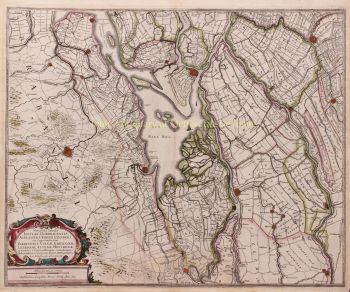
17TH-CENTURY UTRECHT 1652
Joan Blaeu
Papel
38 ⨯ 50 cm
€ 1.650
Inter-Antiquariaat Mefferdt & De Jonge
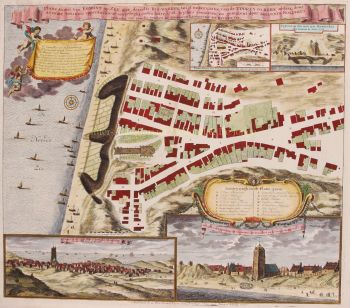
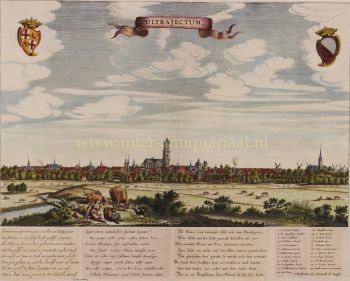
- Sobre la obra de arte17TH-CENTURY UTRECHT “Traiectum Wttrecht,” copper engraving published by Joan Blaeu, ca. 1649 in his famous town book of the Netherlands: "Het Toneel der Steden van de Vereenigde Nederlanden met hare Beschrijvingen" [The Theatre of the Cities of the United Netherlands with their Descriptions]. Coloured by a later hand. Size approx. 38 × 50 cm. The copperplate from which the print was made must have been engraved between 1642 and 1649, since the Smeetoren, which was converted into an astronomical observatory in 1642, is indicated in the legend (no. 56) as “observatorium.” The map reflects the situation of 1642–1644, as the Pieterstraat—laid out in 1644—does not yet appear. The map contains several inaccuracies: the Salvatorkerk, already demolished in 1587, is still depicted; the Catharijne Gate is shown in its pre-1625 form; and the Vaartse Rijn and Oude Rijn are incorrectly oriented. After the founding of the university in 1636, the city created a sports field outside the city moat for the students, where the then-popular game of jeu de mail could be played (legend no. 53: Palle maille baen). With its six pall-mall players and rows of trees, the map provides a clear impression of this 17th-century recreation ground. The Amsterdam cartographer and publisher Joan Blaeu sought to fulfill the ambitions of earlier mapmakers Abraham Ortelius and Georg Braun & Frans Hogenberg by adding a series of city books to his multi-volume world atlas. Blaeu’s Toneel der Steden van de Vereenighde Nederlanden appeared in a Latin edition in 1649; the Dutch edition was printed in 1652. Some of the maps included in the work had already been published in earlier atlases—21, for instance, in Marcus Boxhorn’s Theatrum Hollandiae of 1632—while others were newly engraved specifically for Blaeu’s town book. It is known that Blaeu sent letters to city councils requesting that they provide him with a city plan and a written description to include in his work. Literature: “Kaarten van Utrecht” – Donkersloot de Vrij (1989), no. 14 Prijs Euro 1.650,-
- Sobre el artista
Joan Blaeu (1596-1673), nació el 23 de septiembre de 1596 en Alkmaar.
Fue un cartógrafo holandés nacido en Alkmaar. Siguió los pasos de su padre, el cartógrafo Willem Blaeu.
En 1620 se doctoró en derecho pero se incorporó a la obra de su padre. En 1635 publicaron el Atlas Novus (título completo: Theatrum orbis terrarum, sive, Atlas novus) en dos volúmenes. Joan y su hermano Cornelius se hicieron cargo del estudio después de la muerte de su padre en 1638. Joan se convirtió en el cartógrafo oficial de la Compañía Holandesa de las Indias Orientales.
El mapa del mundo de Blaeu, Nova et Accuratissima Terrarum Orbis Tabula, que incorpora los descubrimientos de Abel Tasman, se publicó en 1648. Este mapa fue revolucionario porque "representa el sistema solar de acuerdo con las teorías heliocéntricas de Nicolaus Copernicus, que muestran la Tierra girando alrededor el sol... Aunque el innovador libro de Copérnico Sobre las revoluciones de las esferas se imprimió por primera vez en 1543, poco más de un siglo antes, Blaeu fue el primer cartógrafo en incorporar esta revolucionaria teoría heliocéntrica en un mapa del mundo".
El mapa de Blaeu se copió para el mapa del mundo colocado en el pavimento del Groote Burger-Zaal del nuevo Ayuntamiento de Ámsterdam, diseñado por el arquitecto holandés Jacob van Campen (ahora el Palacio Real de Ámsterdam), en 1655.
La Hollandia Nova de Blaeu también se representó en su Archipelagus Orientalis sive Asiaticus publicado en 1659 en el Kurfürsten Atlas (Atlas del Gran Elector). y utilizado por Melchisédech Thévenot para producir su mapa, Hollandia Nova—Terre Australe (1664).
Como "Jean Blaeu", también publicó el volumen 12 "Le Grand Atlas, ou Cosmographie blaviane, en laquelle est exactement descritte la terre, la mer, et le ciel". Una edición está fechada en 1663. Era un folio (540 x 340 mm) y contenía 593 mapas y láminas grabados. En marzo de 2015, se puso a la venta una copia por 750.000 libras esterlinas.
Alrededor de 1649, Joan Blaeu publicó una colección de mapas de ciudades holandesas llamada Toonneel der Steeden (Vistas de ciudades). En 1651 fue votado en el consejo de Ámsterdam. En 1654 Joan publicó el primer atlas de Escocia, ideado por Timothy Pont. En 1662 reeditó el Atlas Novus, también conocido como Atlas Maior, en 11 volúmenes y uno para los océanos.
Se planeó una cosmología como su próximo proyecto, pero un incendio destruyó el estudio por completo en 1672.
Joan Blaeu murió en Amsterdam el año siguiente, 1673. Fue enterrado en Westerkerk en Amsterdam.

¿Está interesado en comprar esta obra de arte?
Artwork details
Related artworks
- 1 - 4 / 12
Artista Desconocido
Dutch School pair of equestrian paintings 1650 - 1750
Precio a consultarGallerease Selected
1 - 4 / 24- 1 - 4 / 24
Jean-François Rauzier
Oasis Hotel - Limited edition of 8 2017
Precio a consultarVilla del Arte Galleries
1 - 4 / 24- 1 - 4 / 24
- 1 - 4 / 12


![RARE ARMORIAL MAP: LEO BRABANTIAE Lion of the most noble Duchy of Brabant] by Sibertus Waterloos](https://media-3.gallerease.com/images/325cc033-a3b6-495f-9da8-6d06caf29b14/350x350/rare-armorial-map-leo-brabantiae-lion-of-the-most-noble-duchy-of-brabant.jpg)


![European hunting party] by Artista Desconocido](https://media-2.gallerease.com/images/cb8cbebf-7709-4817-9bdb-fef8ae1e93cf/350x350/european-hunting-party.jpg)