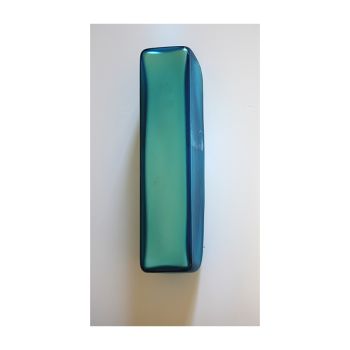
A glass art-object “Panther”, model SH 100 – Nuutajärvi-Notsjö Finland 1957 by Saara Hopea

A glass art-object “Panther”, model SH 100 – Nuutajärvi-Notsjö Finland 1957 1957

Saara Hopea

Vidrio
16 cm, ø 7 cm
ConditionVery good
€ 1.450

Van Kerkhoff Art

  • Sobre la obra de arte
    A free-blown, clear glass Art-object withn moss-green spots “Panther”, model SH 100. Designed by Saara Hopea in 1954 and executed by Nuutajärvi-Notsjö in 1957.

    The ‘Panther’ or ‘Pantteri’ art-objects were made in two variants, the SH 100 and SH 109. This object is a model SH 100 which is cylindrical in form. These objects were made between 1954 and 1961 in two sizes and either made with moss-green spots or lilac spots.

    This particular example is in very good condition and is marked and dated in diamond pen underneath the base: S. Hopea Nuutajärvi-Notsjö ’57.


    About Saara Hopea
    Saara Elisabet Hopea (Porvoo 1925 – Porvoo 1984) was a Finnish designer of Art-glass, furniture and jewellery.

    Saara Hopea was born in 1925 in Porvoo, in the south of Finland. Her parents Ossian Hopea and Lempi Westerlund owned a goldsmithing company.

    After attending secondary school, Hopea studied at the Interior Design Department of the Central School of Art and Design, now the Aalto University of Art and Design.

    She graduated in 1946, and worked for a few years as an illustrator, then she accepted a job at the lighting factory of Taito Oy, headed by the renowned designer Paavo Tynell.
    In the early 1950’s, Saara Hopea became interested in glass design and started working at the Nuutajärvi glass factory, where she worked under artistic director Kaj Franck.

    After her father’s death, Saara Hopea took over the direction of the family business Ossian Hopea Oy in 1959. She worked as the artistic director from 1959 to 1960 and again from 1967 and was responsible for numerous jewellery designs.

    In 1960 Saara Hopea married Oppi Untracht , an American goldsmith, photographer and writer, and they moved to New York City. Together with her husband, Saara Hopea also lived in Nepal and in India over the years until 1967, after which the couple settled permanently in Porvoo.

    For her glass designs, Saara Hopea received a silver medal at the Milan Triennials in both 1954 and 1957. She also received the Porvoo City Culture Prize in 1981 and the State Arts and Crafts Prize in 1982.

    Her retrospective exhibition was held at the Museum of Arts and Crafts in Helsinki in 1987. 28 of her works are in the collection of The British Museum in London and the MoMa in New York holds 11 of her works.

    Marked
    Marked in diamondpen underneath the base: S. Hopea Nuutajärvi-Notsjö '57 (1957)

    Execution
    Nuutajärvi-Notsjö glassworks, Finland 1957

    Condition
    This Art-object is in good vintage condition. Basic wear consistent with age and use. No chips or cracks.

    Literature
    Oppi Untracht – Saara Hopea-Untracht: her life and work. P 98 (illustrated), P 303

    Dimensions
    Height 16 cm
    Diameter 7,5 cm
  • Sobre el artista

    Saara Hopea tuvo una carrera prolífica en varios campos del diseño, dejando una huella significativa en el panorama artístico finlandés de la década de 1950. Su viaje comenzó en el ámbito del diseño de muebles, donde perfeccionó sus habilidades desde 1946 hasta 1948. En busca de nuevas oportunidades, unió fuerzas con la renombrada compañía del orfebre Paavo Tynell, donde trabajó hasta 1952.

    Durante este tiempo, contribuyó a la cristalería Nuutajärvi, donde sus creaciones se convirtieron en una brillante encarnación de la estética minimalista que definió el estilo finlandés en la década de 1950, influenciada por los principios de la filosofía de diseño Bauhaus. En particular, después de la muerte de su padre en 1948, asumió la tarea de diseñar cubiertos para su tienda en Porvoo.

    Un punto de inflexión en la vida de Hopea ocurrió cuando se casó y se mudó a Nueva York con su esposo. Fue aquí donde se embarcó en un nuevo camino artístico, explorando el ámbito del trabajo del esmalte. A través de su experimentación con esmaltes transparentes sobrecocidos sobre cobre, logró resultados notables que otorgaron a sus piezas un aspecto espontáneo y pictórico, caracterizado por colores vibrantes y una profundidad notable. Sus exquisitas creaciones de esmalte llegaron a manos de clientes exigentes a través de tiendas exclusivas.

    La sed de conocimiento e inspiración artística de la pareja los llevó a embarcarse en un extraordinario viaje a través de Nepal y la India, que duró cuatro años. Durante este tiempo, se sumergieron en el estudio, la fotografía y la colección de orfebrería y joyería local. En 1997, su esposo, profundamente influenciado por sus experiencias, publicó "Joyería tradicional de la India", un testimonio de su exploración y apreciación del rico patrimonio artístico de la región. En 1967, regresaron a Porvoo, donde los esfuerzos artísticos de Hopea abarcaron una amplia gama de disciplinas, incluida la orfebrería, el diseño textil y el esmaltado.

    El impacto del talento y el arte de Saara Hopea se extiende más allá de las fronteras de Finlandia. El Museo Británico cuenta con una colección de 28 de sus obras, mientras que el Museo de Arte Moderno tiene 11 artículos preciosos, testimonio de su legado perdurable. En 1988, su marido publicó un relato completo de su vida y obra titulado "Saara Hopea-Untracht: Vida y obra", que arroja luz sobre el notable viaje artístico de esta tranquila visionaria escandinava.

¿Está interesado en comprar esta obra de arte?